
During the landing roll, the pilot sees three yellow lights beside the runway centre line, then two, then one. These rapid exit taxiway indicator lights (RETILs) tell the pilot how far it is to the next rapid exit taxiway.
Each light carries part of that message, so positions are fixed to the metre and one failed light takes the whole set out of service. The first question is whether the runway needs them.
When a runway needs them
In China, MH 5001-2021 clause 7.5.7 (1) applies: RETILs shall be provided on a runway used in RVR below 350 m, or where traffic density is heavy.
ICAO's trigger is narrower and its wording softer. Amendment 18 to Annex 14 Volume I, applicable from 27 November 2025, recommends RETILs for runways used in RVR below 300 m and/or with heavy traffic density (5.3.15.1). It is a recommendation, not a requirement.
Many sources online still give 350 m as the ICAO figure; that was the original 9th edition text. Because the MH 5001 trigger is wider and its wording stronger, a runway designed to MH 5001 also covers the ICAO recommendation.
How to lay out the 3-2-1
Each rapid exit gets six lights in three rows, on the same side of the runway centre line as the exit. Three lights stand 300 m before the point of tangency of the exit centre line, two at 200 m and one at 100 m. Within a row the lights are 2 m apart, and the innermost light is 2 m from the runway centre line. MH 5001 and ICAO use the same layout values.
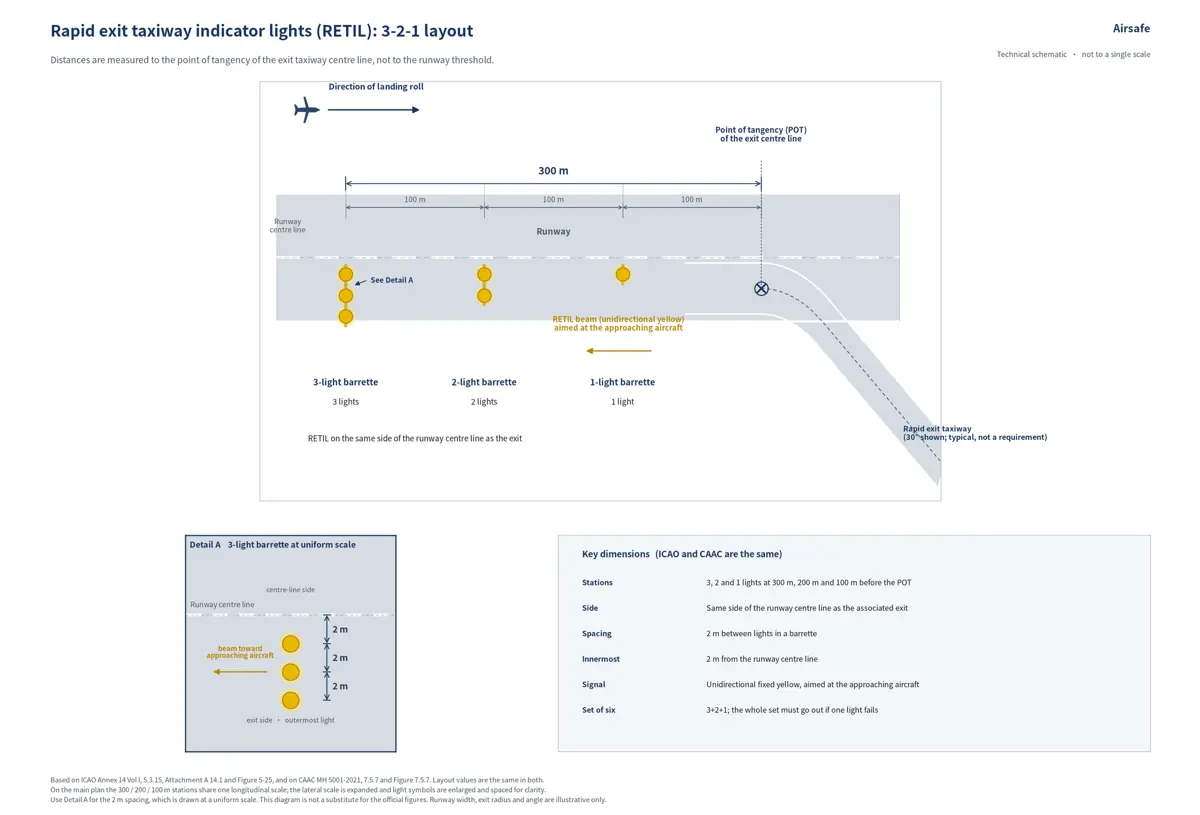
Setting-out errors usually start at the reference point: all three rows are measured back from the point of tangency, not from the threshold. If the exit alignment changes, all six lights move with it, so fix the exit geometry before drawing bases and cable routes. Where a runway has several rapid exits, two sets in operation must not overlap.
RETILs are unidirectional, fixed yellow lights aimed at the approaching aircraft, against the direction of the landing roll. Intensity is the white value of the runway centre line light diagram multiplied by 0.40. With centre line lights at 30 m spacing (Figure E.6 / A2-6), the minimum average main-beam intensity is 2,000 cd. At 15 m spacing the values in Figure E.7 / A2-7 vary, so cite the figure rather than a single number.
RETILs are the yellow countdown on the runway. Do not confuse them with the exit's green and yellow taxiway centre line lights, which lead the aircraft off along the curve.
One light out, all six go dark
Why switch off five good lights because one has failed? A broken 3-2-1 gives the wrong distance. With one light out in the first row, the pilot sees two and reads 200 m to the exit when it is really 300 m. A false cue is worse than none, so MH 5001 and ICAO both require the whole set of six to go dark.
That rule shapes the electrical design. Under MH 5001, RETILs shall be supplied on a circuit separate from other runway lighting. The standard recommends using the associated exit's taxiway centre line lighting series circuit, with a design that switches off all six RETILs if the complete pattern cannot be displayed. ICAO 5.3.15.7 recommends a circuit separate from other runway lighting.
Whole-set switch-off is a function of the constant current regulator (CCR) or monitoring system, since one fixture cannot turn off its neighbours. With a shared circuit, settle early how the six RETILs go dark while the centre line lights stay on.
Airsafe's RAPS-08-LED and RAPZ-08-LED offer optional fault detection that presents an open-circuit fault at the fixture if the LED or driver fails. Single-lamp fault detection and whole-set switch-off must be verified with the isolation transformers, CCR and monitoring design.
Choosing the fixtures
A RETIL sits in the touchdown and roll-out zone, under main gear and snow ploughs, so protrusion matters. Take Airsafe's 8-inch inset range. The LED models protrude 6 mm, which is class 2 in CAAC specification AC-137-CA-2015-03 (H ≤ 6.3 mm; class 1 is 6.3 mm < H ≤ 12.5 mm). The same document treats RETILs as the same type as runway centre line lights: L-1D for 30 m spacing and L-1E for 15 m.
Model | Key point | Link |
|---|---|---|
RAP-08 | Halogen, for circuits that stay halogen; self-aligning optics, flat window against standing water. | |
RAPS-08-LED | LED, 6 mm protrusion; optional fault detection. | |
RAPZ-08-LED | LED Zero Water design, 6 mm protrusion, optional fault detection. |
Keep one model and one light source within a set. Mixed LED and halogen can look uneven at low brightness steps.
For a quotation
For a quotation, send the runway centre line light spacing, the position of each rapid exit, the standard the project follows (MH 5001 or ICAO) and whether the circuit will stay halogen. For replacements, add the existing nameplate, base drawing and CCR details. Contact Airsafe's engineering team
Related guide: Choosing Runway Threshold, Wing Bar and End Lights.
References:
MH 5001-2021 Technical Standards for Airfield Area of Civil Airports (currently effective version)
ICAO Annex 14, Volume I, Amendment 18
AC-137-CA-2015-03 Technical Requirements for Runway and Taxiway Lights
Frequently asked questions
What are rapid exit taxiway indicator lights?
They are unidirectional, fixed yellow lights beside the runway centre line. In a 3-2-1 pattern, they tell a landing pilot the distance to the next rapid exit taxiway.
When does a runway need RETILs?
In China, MH 5001-2021 clause 7.5.7 requires them on runways used in RVR below 350 m or with heavy traffic. Under Amendment 18, ICAO recommends them below 300 m RVR and/or with heavy traffic density (5.3.15.1).
How is the 3-2-1 laid out?
Three, two and one lights stand 300 m, 200 m and 100 m before the exit centre line's point of tangency, on the exit side. They are 2 m apart, with the innermost 2 m from the runway centre line.
What happens if one light fails?
The whole set of six must be switched off. A partial pattern would give the pilot a false distance to the exit.
How should RETILs be powered?
Under MH 5001, RETILs shall be supplied on a circuit separate from other runway lighting. The standard recommends using the associated taxiway centre line lighting series circuit, with a design that switches off all six RETILs if the complete pattern cannot be displayed.